Thursday, March 24, 2011

El descaro de los invasores a Libia: “Vengan con nosotros y únanse a esta ‘transición democrática’”

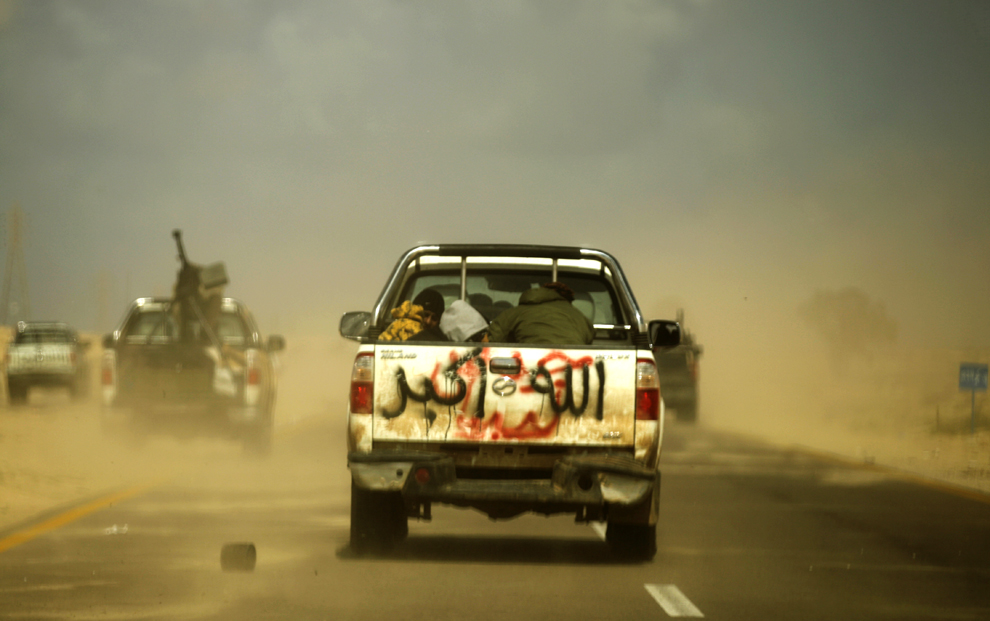
La invasión trasladó por primera vez sus operaciones a las ciudades de Al Yubra y Sebha, bastiones de la tribu Guededfa, de la que forma parte el líder libio. Francia desmintió la caída de uno de sus aviones. ”Los bombardeos empezaron a partir de las 02H00 locales. Hemos escuchado aviones y disparos de baterías antiaéreas y luego varias explosiones”, relató un habitante de Sehba citado por agencias internacionales.

Es la primera vez que la invasión que lideran EEUU, Francia y el Reino Unido, realizan operaciones en ciudades ubicadas al sur de Trípoli, una región bajo dominio absoluto del gobierno. El líder libio ha centrado sus ataques en las ciudades del este controladas por la oposición.

Al mismo tiempo, el diario digital libio Al Watan había informado sobre la caída de un avión de avión francés en la ciudad natal del líder libio. “Ningún avión francés fue derribado en Sirte la noche pasada”, dijo el coronel Thierry Burkhard, vocero de las Fuerzas Armadas de Francia.

El aparato de propaganda del gobierno ha acelerado su campaña contra los ataques aliados. La televisión mostró imágenes de cadáveres parcialmente carbonizados. Fuentes opositoras rechazaron, sin embargo, que se tratara de civiles muertos en los ataques aéreos de la invasión internacional.

Desde que comenzaron los ataques aéreos para imponer una zona de exclusión aérea sobre Libia, el sábado pasado, la oposición ha tildado de falsas las informaciones de los medios estatales sobre supuestas víctimas civiles. En tierra, los enfrentamientos entre las tropas leales a Gadafi y los rebeldes se centran en estos momentos en las ciudades de Aydabiya y Misurata, al este de Trípoli.

El Pentágono insistió este jueves en que había establecido con éxito una zona de exclusión aérea sobre las zonas costeras de Libia y afirmó que había pasado a atacar la artillería de Gadafi. En sintonía, Gran Bretaña señaló que había lanzado misiles guiados Tomahawk desde un submarino clase contra defensas aéreas libias. Y el ministro de Defensa francés, Gerard Longuet, indicó que su país destruyó unos 10 vehículos blindados libios durante tres días.

Mucho más lejos fue el oficial de alto rango de la Royal Air Force británica, Greg Bagwell, quien señaló que la aviación libia “ya no existe como fuerza de combate”. Sin embargo, los tanques de Gadafi se acercaron a la estratégica ciudad de Misrata, la tercera más grande del país, aún en poder de los rebeldes. Al amparo de la oscuridad, comenzaron a disparar contra el área cerca del hospital principal, dijeron residentes y rebeldes, con lo que reanudaron su ataque luego de que sus armas fueran silenciadas durante el día por los bombardeos aliados.

En la capital, la defensa antiaérea del gobierno comenzó a disparar en la madrugada local y se escucharon luego varias explosiones. A su vez, al comenzar la noche, se había producido una fuerte explosión en una base del ejército libio, a 32 kilómetros al este de Trípoli. Luego los testigos vieron llamas en el lugar.

La agencia oficial Jana había indicado, entonces, que los bombardeos de la coalición internacional en los suburbios de Trípoli el miércoles por la noche, que tuvieron como objetivo “un barrio residencial”, dejaron “una importante cantidad de muertos entre los civiles”. Según la agencia, un “tercer bombardeo” de la invasión “tomó como blanco a los socorristas que estaban trabajando para extraer los muertos y heridos” en el lugar. También denunció que hubo muertos civiles en Jafra, en Jemil, en Misrata y al sur de Bengasi.

La información fue desmentida por el Pentágono. En sintonía, al ser interrogado sobre los disparos de la invasión que afectaron a civiles, el canciller francés Alain Juppé, respondió que lo que se produjo “es exactamente lo contrario”. Sin embargo, fuentes distintas afirmaron que la invasión a Libia ha cobrado más civiles inocentes que personas cercanas a Gadafi.

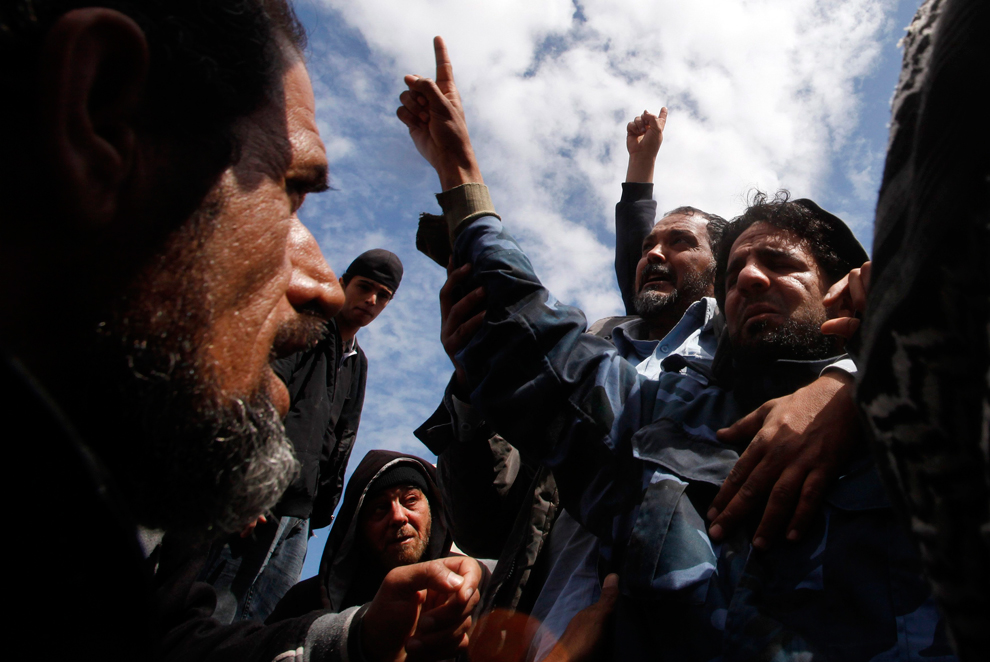
El líder libio niega que su ejército esté realizando cualquier operación ofensiva y sostiene que sus tropas sólo se están defendiendo cuando son atacadas. Pero un residente en Zintan, al suroeste de Trípoli, dijo que las fuerzas del Gadafi están reuniendo más tropas y tanques para bombardear a los invasores.

Mientras, las fuerzas rebeldes en el este aún están detenidas afuera de Ajdabiyah, una ciudad clave, luego de intentar recapturarla por más de tres días.

“Nosotros continuaremos los ataques aéreos. Tomamos como blanco a los medios militares y nada más”, afirmó el ministro de Relaciones Exteriores francés, Alain Juppé, a la emisora RTL. “Esto continuará el tiempo que sea necesario”, agregó, considerando que el comienzo de las operaciones desde el sábado pasado era “un éxito”.

“La solución puramente militar no existe. En un momento dado, deberá esbozarse un proceso político”, afirmó, de su lado, la presidencia gala en un comunicado.

No obstante, indicó que “no incumbe a los europeos dictar el proceso a los libios”. Y concluyó: “En cambio, animamos a los libios a desertar, unirse a las oposiciones que se expresan, a unirse en un proceso de transición democrática”.

http://wmaracaibo.com/?p=22942

Libya/Civilian War: Like Vitnam 2000 US Marines on ground in Libya, says ABC

An ABC affiliate in North Carolina says more than 2,000 U.S. Marines are on the ground in Libya.

WCTI-TV in New Bern reports those Marines, assigned to the 26th Marine Expeditionary Unit (MEU) at Camp Lejuene, are "preserving the sanctity of the city [of Ajdubiyah] and the safety of the civilians within it."

Capt. Timothy Patrick with the 26th MEU told the station: "In Libya right now they are doing exactly what we need them to do. They are doing what they are told, and right now that's protecting Libyan people against Qadhafi forces."

Evidently the Marines' efforts are being successful. The commanding officer of the 26th MEU, Col. Mark Desens, says that following a second round of strikes by AV-8B Harrier jets, the Libyan dictator's forces "are now less capable of threatening the town than before."

According to the report, the 2,200 Marines with the 26th MEU are nearing the end of their deployment in the Mediterranean area and are due to be replaced with Marines from the 22nd MEU out of Camp Lejeune. A March 7 notice from the commanding officer of the 22nd MEU says that unit was being deployed to the Mediterranean Sea earlier than previously planned.

The new face of war: A female general commands the U.S. air campaign in Libya 2011

This is the general overseeing the American part of the air campaign in Libya. Air Force Maj. Gen. Margaret Woodward, commander of the 17th Air Force, based in Germany, seems to be an expert in refueling and mobility, which is probably why she was picked for Africa Command, whose planners likely expected the command mainly to be doing humanitarian relief missions. Instead she is overseeing airstrikes by B-2 bombers, F-15E fighter/bombers, and F-16 CJ jammers.

To my knowledge, this is the first time a woman has ever overseen an air campaign.

Tuesday, March 22, 2011

U.S. Treasury Identifies 14 Companies Owned By Libya’s National Oil Corporation As Subject To Sanctions

WASHINGTON--(ENEWSPF)--March 22, 2011.  The U.S. Department of the Treasury’s Office of Foreign Assets Control (OFAC) today identified 14 companies owned by Libya’s National Oil Corporation, as subject to sanctions pursuant to Executive Order (E.O.) 13566.

The National Oil Corporation is the centerpiece of Libya’s state-owned oil apparatus, and controls a network of companies involved in oil exploration, production, and sale.  E.O. 13566 blocks all property and interests in property of the Government of Libya and its agencies, instrumentalities and controlled entities within U.S. jurisdiction, whether specifically identified by OFAC or not.  U.S. persons are prohibited from engaging in business with any Libyan state-owned entity. Today’s identifications are intended to aid financial institutions in meeting their obligations under E.O. 13566.

“The Libyan National Oil Corporation has been a primary funding source for the Qadhafi regime,” said OFAC Director Adam J. Szubin. “Consistent with UN Security Council Resolution 1973, all governments should block the National Oil Corporation's assets and ensure that Qadhafi cannot use this network of companies to support his activities.”

Treasury will continue monitoring the National Oil Corporation’s operations in Libya.  Should National Oil Corporation subsidiaries or facilities come under different ownership and control, Treasury may consider authorizing dealings with such entities.

OFAC identified the following as companies owned by of Libya’s National Oil Corporation:

  1. Arabian Gulf Oil Company
  2. Azzawiya Oil Refining Company
  3. Brega Petroleum Marketing Company
  4. Harouge Oil Operations
  5. Jamahiriya Oil Well Fluids And Equipment
  6. Mediterranean Oil Services Company
  7. Mediterranean Oil Services GMBH
  8. National Oil Fields and Terminals Catering Company
  9. North African Geophysical Exploration Company
  10. National Oil Wells Drilling and Workover Company
  11. Ras Lanuf Oil And Gas Processing Company
  12. Sirte Oil Company for Production Manufacturing of Oil and Gas
  13. Zueitina Oil Company
  14. Waha Oil Company  ​

Source: treasury.gov

Libya War/ANALYSIS - Libya is biggest gamble yet for France's Sarkozy

* Sarkozy determined to be seen leading action on Libya

* Sarkozy ranked 3rd in some opinion polls for 2012 election

* President risking backlash if Libya mission goes awry

By Catherine Bremer

PARIS, March 22 (Reuters) - Plagued by ruinous poll ratings a year before a likely re-election battle, French President Nicolas Sarkozy pulled off a public relations coup by leaping into the driving seat of the intervention in Libya.

His glory could be short-lived though if what first looked like a heroic operation to save civilians ends up pulling France and its partners into a lengthy and complex foreign conflict.

A rift between Western powers who back the Libyan operation and developing countries who oppose it -- and bickering about who should run it -- raises the spectre of disastrous consequences for the action-man leader if things go awry.

"This is a gamble he's taken and I think it was mainly for domestic reasons," said political analyst Jacques Reland of the Global Policy Institute. "He's a man who doesn't let an opportunity go by, but this could end up as a quagmire. It's very risky and this could be make or break for him."

Waging a foreign war is not an obvious way to win support among the conflict-wary French, but Sarkozy had made it clear he would show leadership over Libya to make up for clumsy handling of the revolts in Tunisia and Egypt.

Muammar Gaddafi made an appropriate target too after Sarkozy came under fire in France for rolling the red carpet out to the Libyan leader in 2007 and letting him pitch his Bedouin-style tent by the Elysee Palace.

That state visit, Gaddafi's first in decades to a Western leader, came after Sarkozy helped get five Bulgarian nurses freed from a Libyan jail in one of a string of swashbuckling foreign missions since he came to power in 2007.

Opinion polls show Sarkozy has now fallen behind far-right leader Marine Le Pen as well as veteran leftists. Ratings below 30 percent make him one of France's least popular presidents ever.

Sarkozy saw France's year-long presidency of the G20 and G8 as opportunities for international grandstanding but has been hampered by a tough debate on his global monetary reform plans and by his poor early handling of unrest in North Africa.

Now he hopes the sight of him summoning world leaders to Paris and being the one to come out and announce action to save Libyans from bloodshed will fill French hearts with national pride.

"The president loves crises with their concomitant surge of adrenalin," Dominique Moisi of the French Institute for International Relations was quoted as saying in a blog.

"Sarkozy is taking a high but legitimate risk that he can retake the moral (and political) high ground."

FAILURE COULD HURT

The possibility of his Libya initiative coming back to bite him is looming larger as the dust settles from the first French strikes, which were minutes away from happening as Sarkozy announced on Saturday that fighter jets were over Libya.

His decision to charge ahead with action within hours of U.N. approval has set off a raft of divisions. Opposition is mounting from China, Russia, Brazil, India and others, and the West is arguing about what role NATO should take in the operation as the United States steps back.

Even before France deployed its jets, Sarkozy's breathless pace of action, coming out early to recognize the rebel opposition and mooting the idea of targeted strikes, irked Germany, which ended up declining to participate.

A chief influence on Sarkozy this month was philosopher Bernard Henri-Levy, who flew to Libya on a fact-finding mission and telephoned Sarkozy from the rebel stronghold of Benghazi.

Sarkozy unveiled the operation in a solemn speech alone at a lectern and left world figures like U.S. Secretary of State Hillary Clinton to arrange private media briefings.

"I do not like the way it was stage-managed," said Reland.

"What makes me ill at ease is whether there was really a danger of massacres in Benghazi. We don't know enough about these insurgents and we don't know enough about Libya."

On Tuesday, Sarkozy made a flying visit to a French air base on the Mediterranean island of Corsica with his defence minister.

France defended itself on Tuesday against reports of rifts with its allies, saying its armed forces chief had told its partners in full about the strikes it planned in Libya.

"The heads of the armed forces of France, Britain and America were in close coordination. Our counterparts were kept up to date on all our intentions and did not show any objections," armed forces spokesman Thierry Burkhard said.

International divisions aside, it is unclear whether Sarkozy stands to gain as much from a successful Libyan intervention as he stands to lose if it all goes wrong.

A survey conducted by pollster IFOP on March 10, before the U.N. resolution on a no-fly zone, found only 30 percent of respondents would support French military action in Libya, compared with 55 percent who in a 2001 poll backed action in Afghanistan. A fresh IFOP poll on Tuesday found 66 percent of French people supported the coalition's Libya intervention.

"It's not the main preoccupation of the French," said IPSOS head Jean-Francois Doridot. Preoccupied by economic gloom, voters might worry about repercussions by terror groups.

Surprisingly few opposition politicians have accused Sarkozy of engineering the operation's timing for political reasons, one exception being National Front founder Jean-Marie Le Pen who is harbouring dreams of seeing his daughter as French president.

"Everyone knows that when things aren't going very well on the home front that's when you get the flag out, sound the bugle," Le Pen told France 2 television on Tuesday.

"You bang the drum to play on people's patriotic reflexes but for us, at any rate, it will not work at all." (Additional reporting by Alexandria Sage and John Irish; Editing by Janet Lawrence)

Monday, March 21, 2011

Libya/War: Latest Pics from battle – Ultimas fotos da guerra em Libia – 21/03/2011


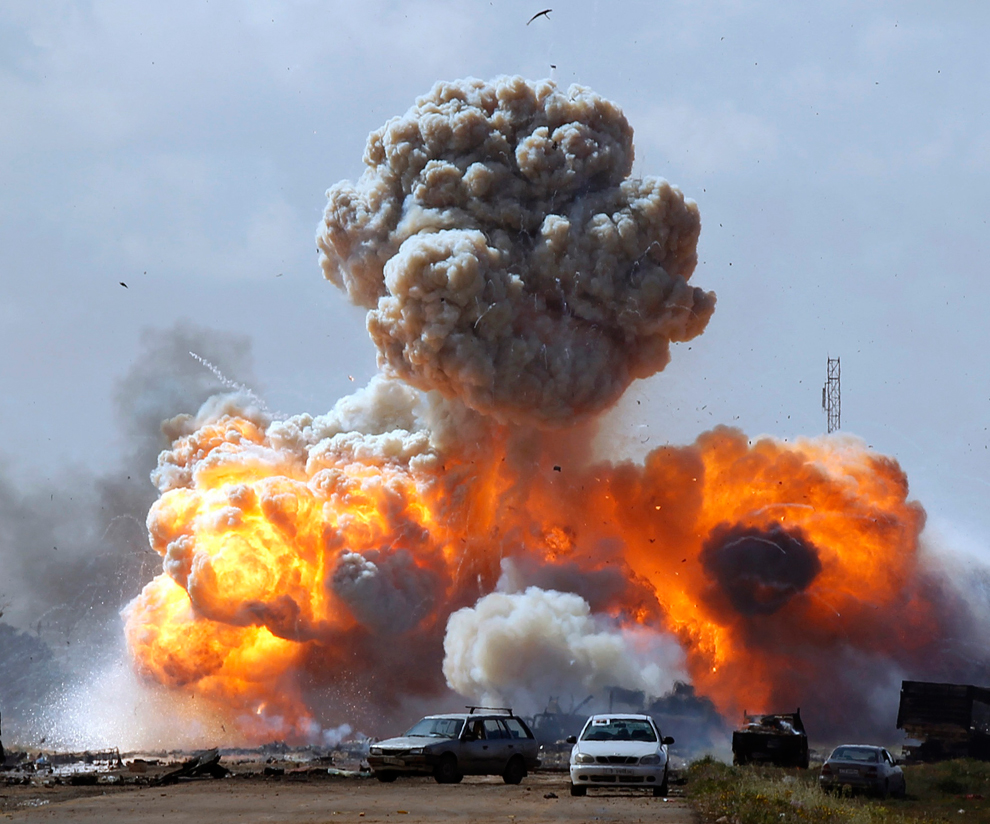
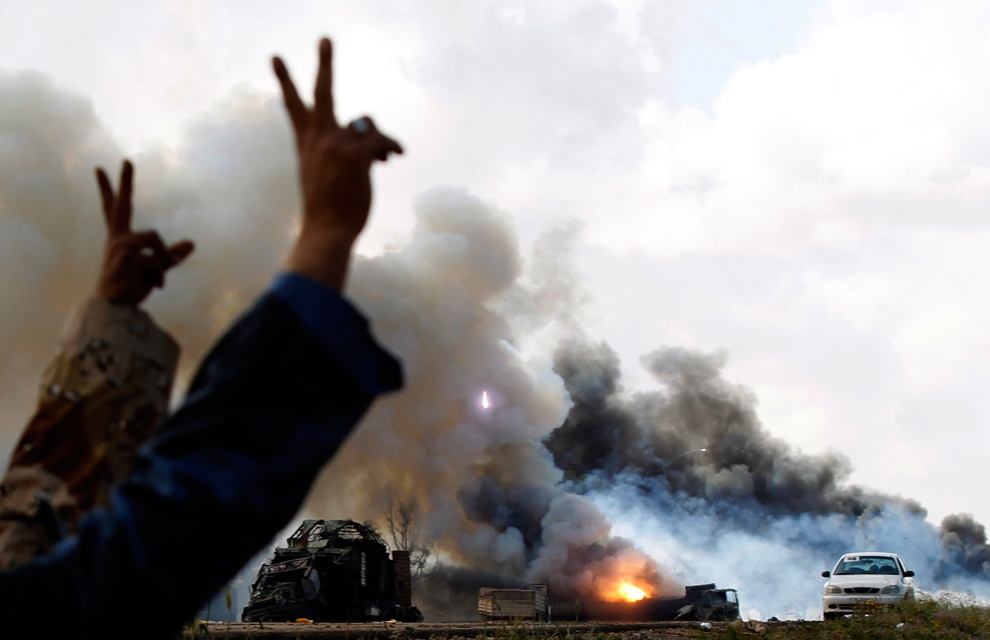
Vehicles belonging to forces loyal to Libyan leader Muammar Qaddafi explode after an air strike by coalition forces, along a road between Benghazi and Ajdabiyah March 20. (Goran Tomasevic/Reuters)


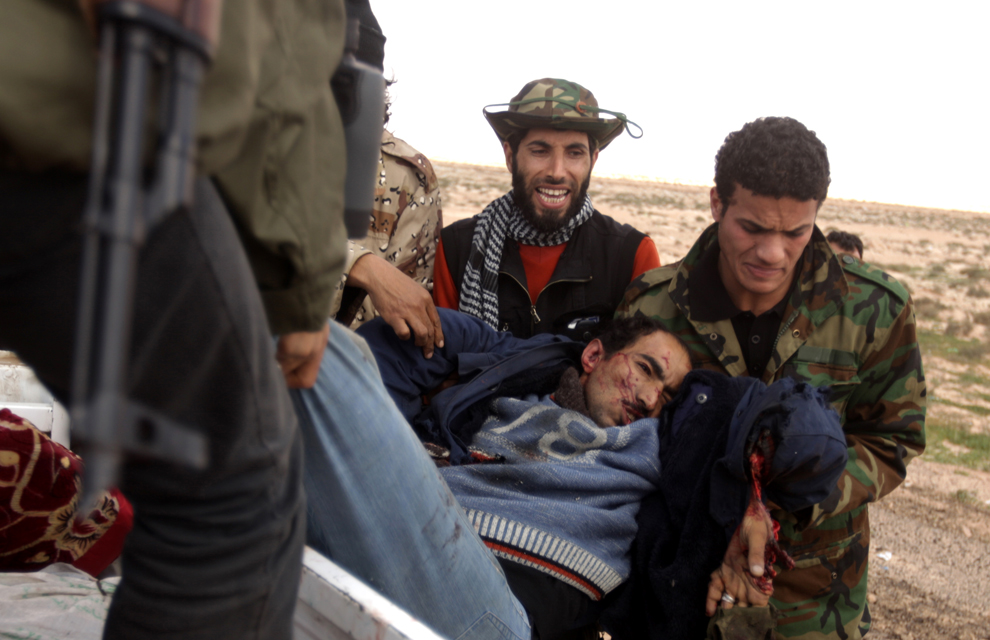
Libyan rebels carry an injured comrade following a failed attempt to take the town of Ajdabiya from Muammar Qaddafi's forces on March 21 as news reports said Libyan government forces pulled back 60 miles from rebel-held Benghazi after Western-led air strikes destroyed much of their armor. (Patrick Baz/AFP/Getty Images)


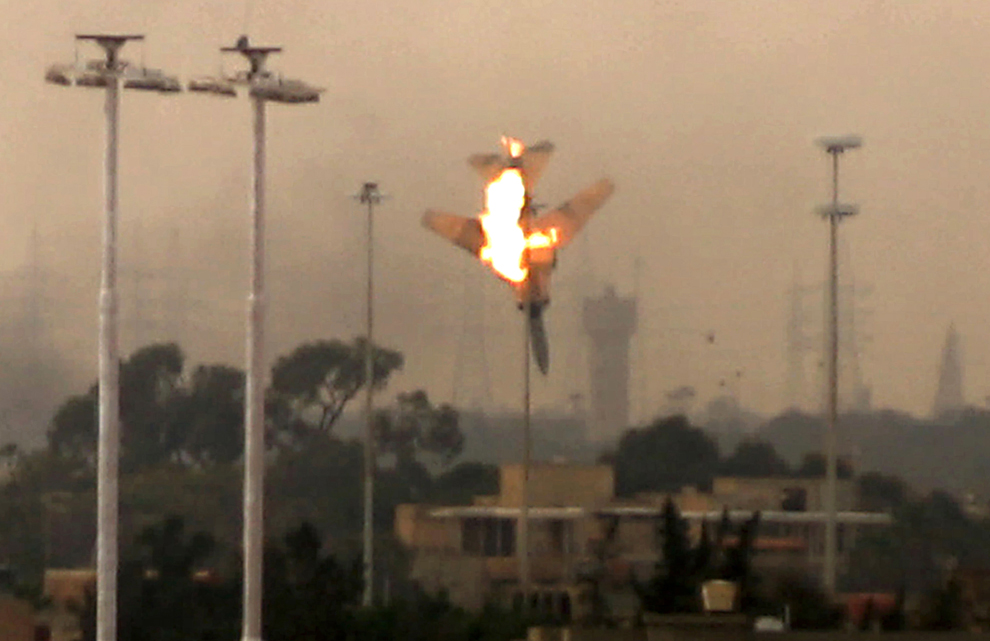
A Libyan jet bomber crashes after being shot down in Benghazi on March 19 as Libya's rebel stronghold came under attack, with at least two air strikes and sustained shelling of the city's south sending thick smoke into the sky. (Patrick Baz/AFP/Getty Images)


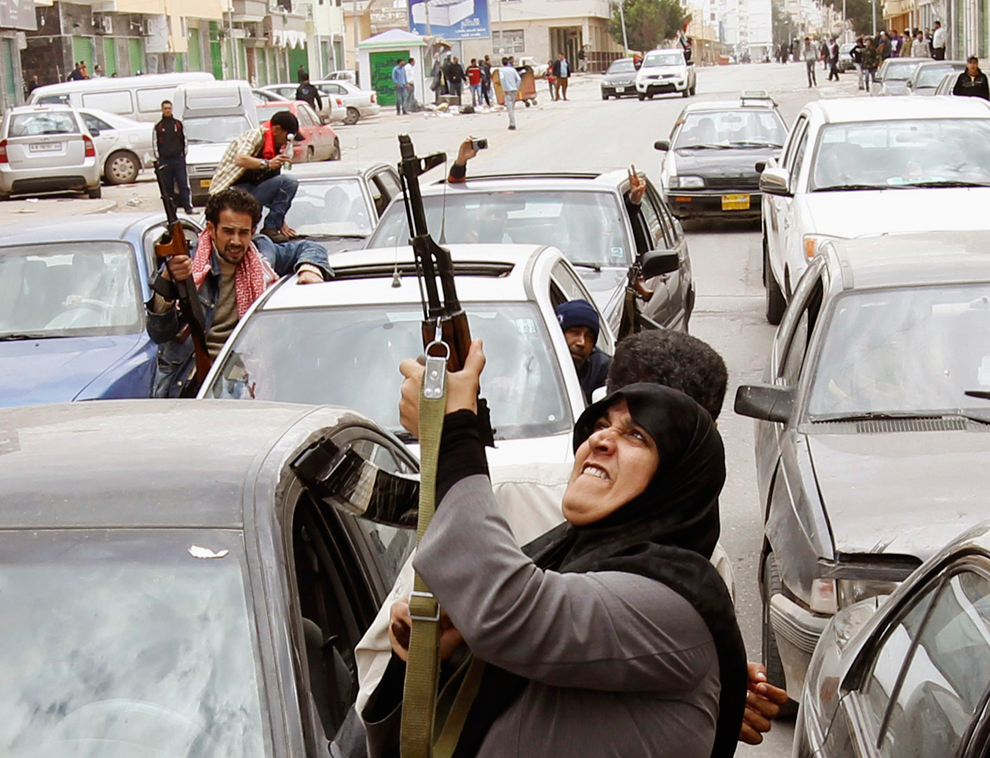
A rebel fighter supporter shoots into the air as she reacts to the news of the withdrawal of Libyan leader Muammar Qaddafi's forces from Benghazi March 19. (Goran Tomasevic/Reuters)


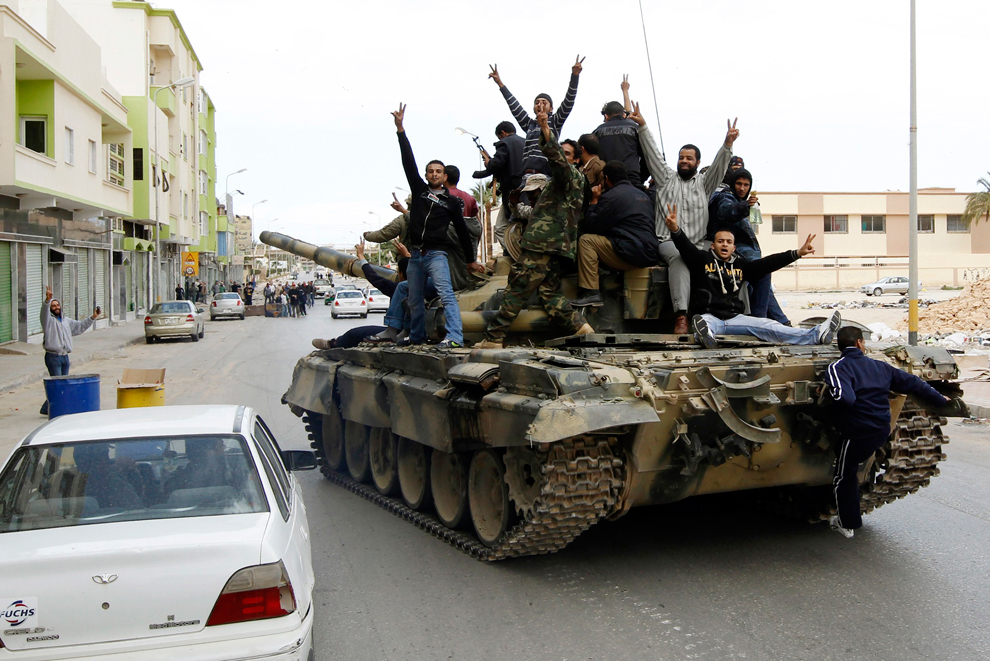
Rebel fighters ride on a tank captured from Libyan leader Muammar Qaddafi's forces in Benghazi March 19. (Goran Tomasevic/Reuters)


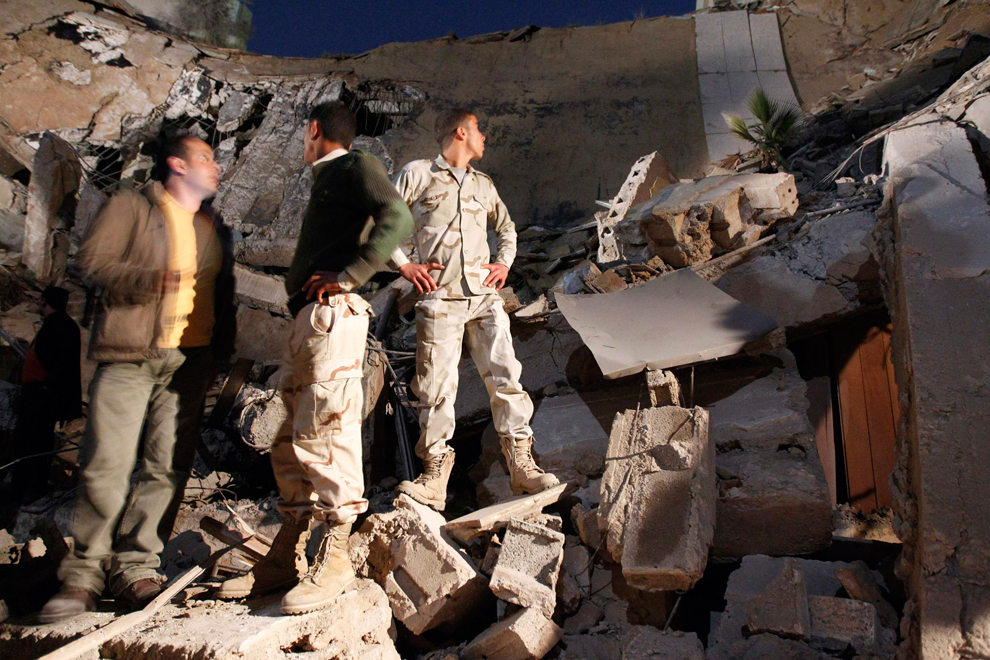
Libyan army soldiers stand on a building, destroyed in what the government said was a Western missile attack, inside Bab Al-Aziziyah, Qaddafi's heavily-fortified Tripoli compound March 21. (Zohra Bensemra/Reuters)


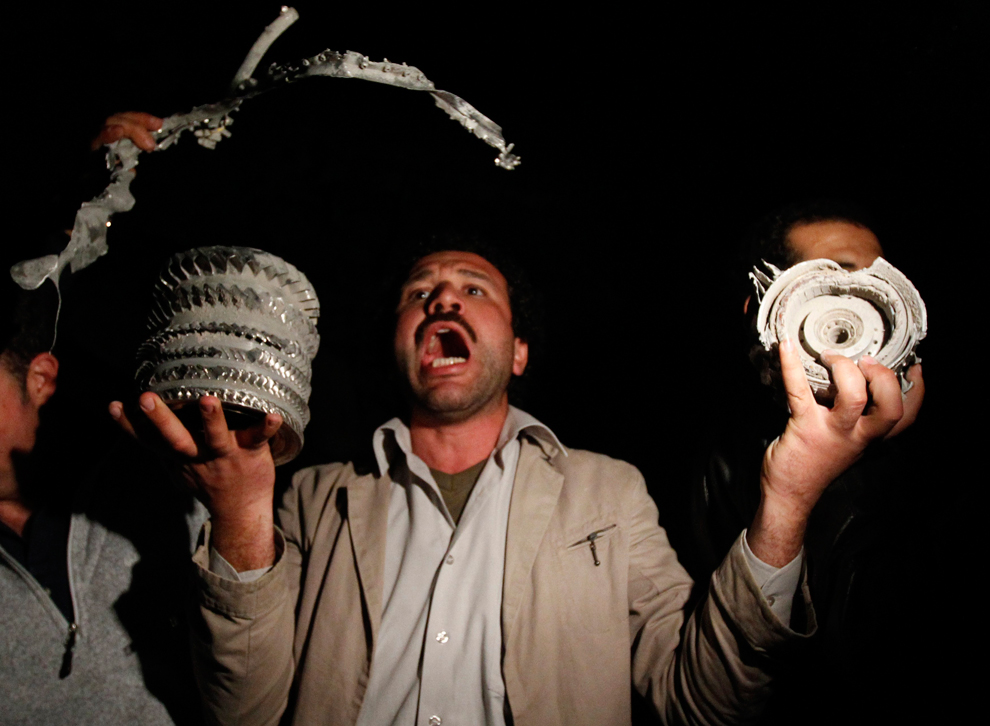
A supporter of Muammar Qaddafi shows pieces of shrapnel from what the government said was a Western missile attack on a building inside Bab Al-Aziziyah, Qaddafi's heavily-fortified Tripoli compound March 21. (Zohra Bensemra/Reuters)


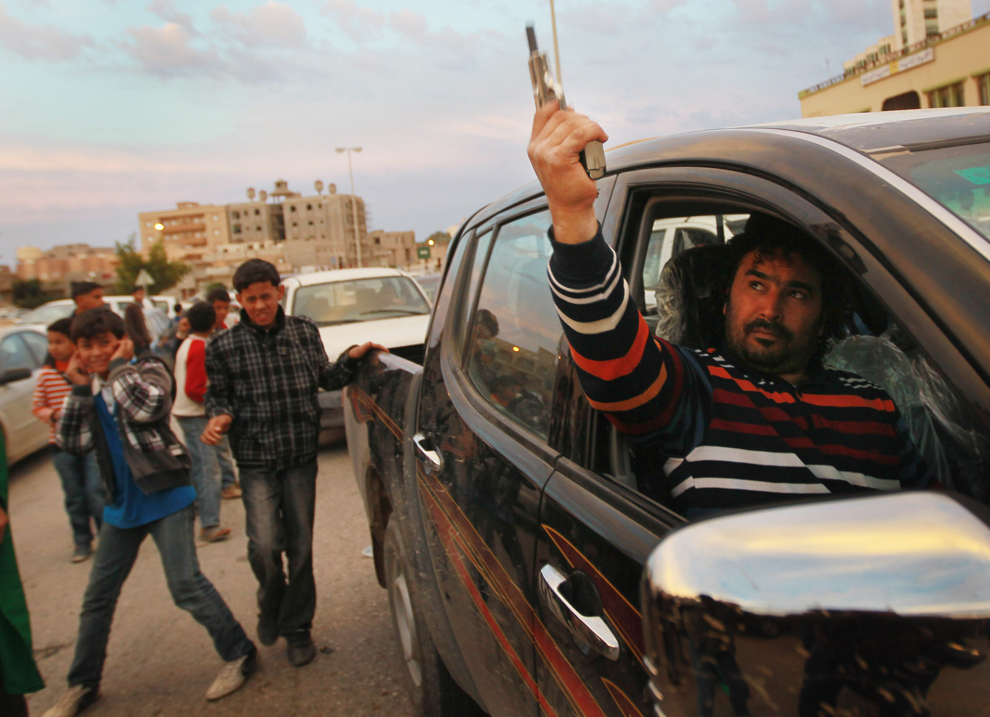
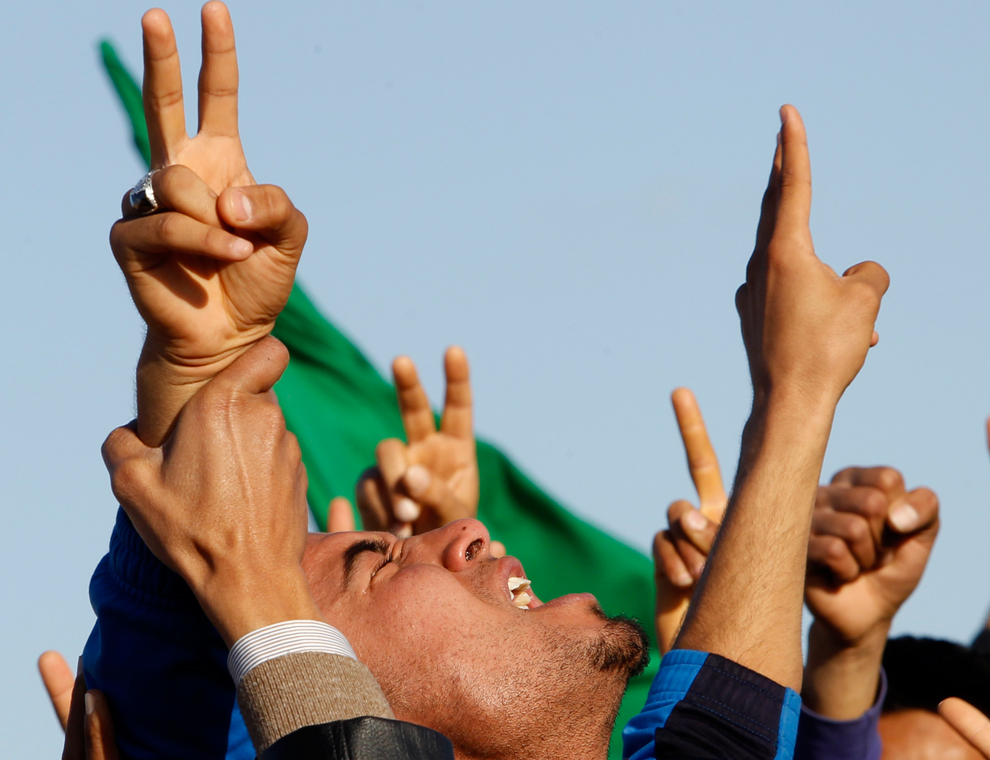
A man fires his pistol in the air during a celebratory rally after the United Nations approved a no-fly zone over the country on March 18 in Tobruk, Libya. Libya declared an immediate cease-fire after the UN vote but reports indicated that Moammar Qaddafi's forces were still shelling two cities. (Joe Raedle/Getty Images)


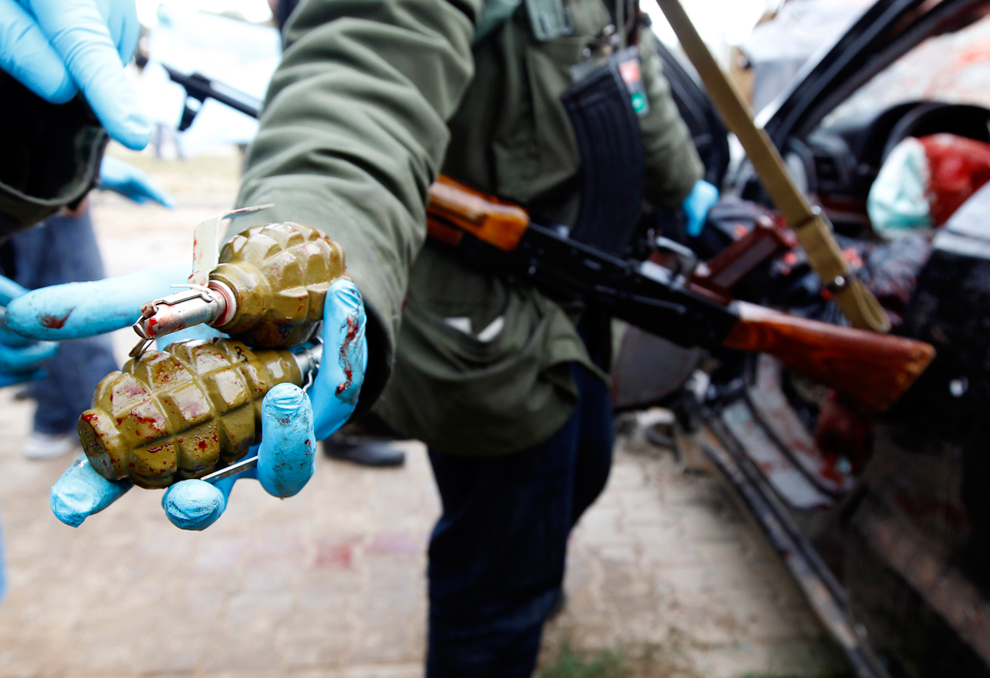
A rebel fighter shows hand grenades found on fighters loyal to Muammar Qaddafi after they were killed by rebel fighters in Benghazi March 19. Qaddafi's forces pushed into the rebel-held city of Benghazi on Saturday, defying world demands for an immediate ceasefire. (Goran Tomasevic/Reuters)


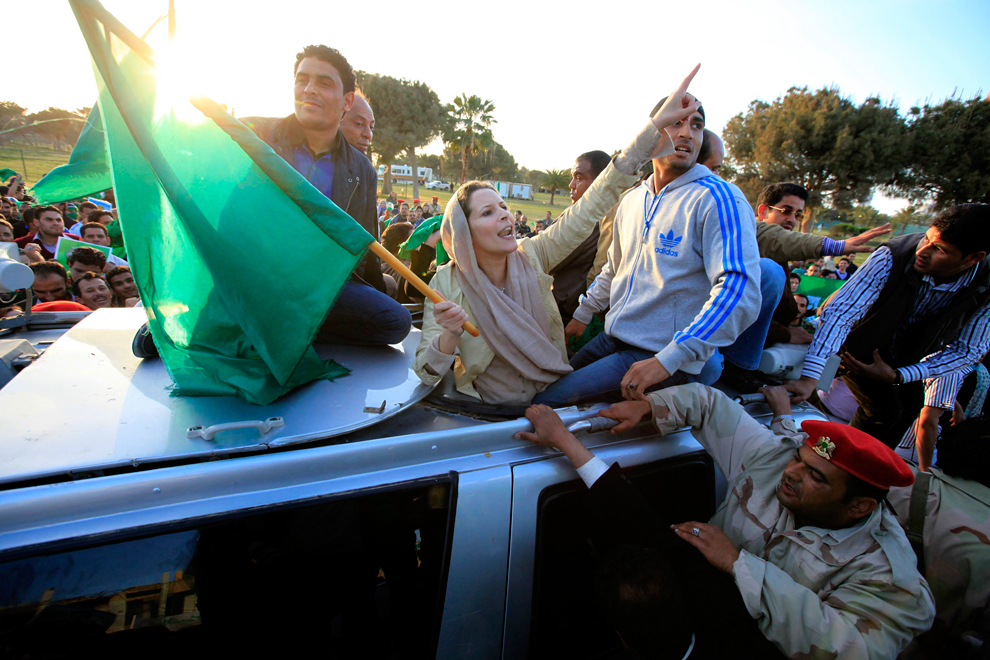
Aisha Qaddafi, daughter of Muammar Qaddafi, holds a Libyan flag as she greets supporters at Bab Al-Aziziyah in Tripoli March 19. Thousands of Libyans packed into Muammar Gaddafi's heavily fortified Tripoli compound on Saturday to form a human shield against possible air strikes by allied forces. (Zohra Bensemra/Reuters)


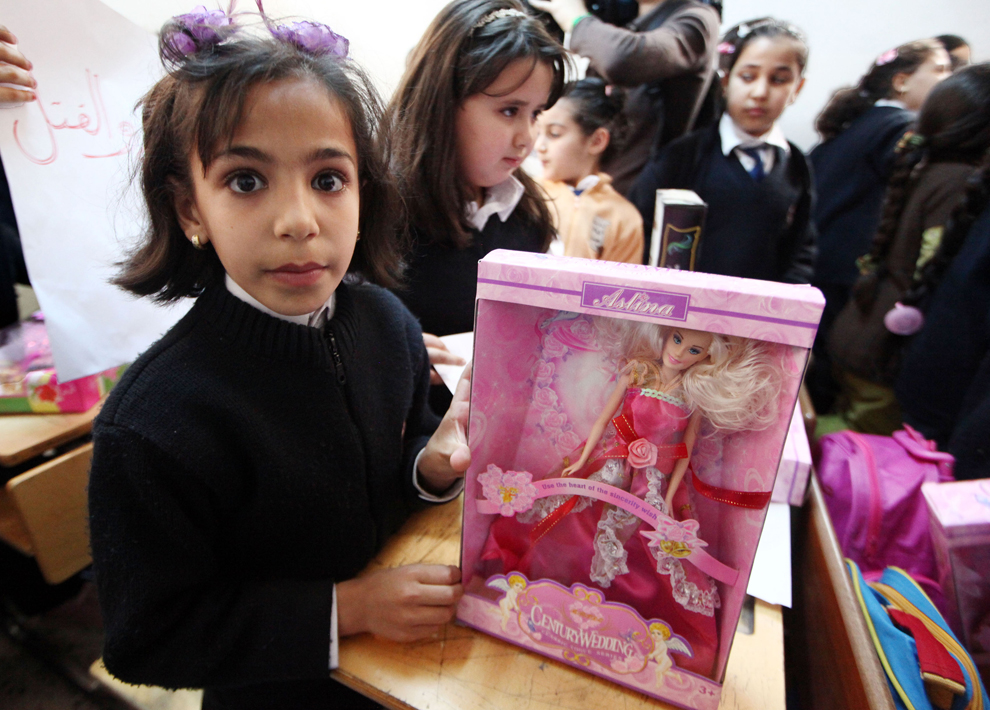
Libyan girls receive gifts from their school during celebrations in their classroom of Children's Day, which was marked in the Libyan capital Tripoli on March 21. (Mahmud TukiaAFP/Getty Images)


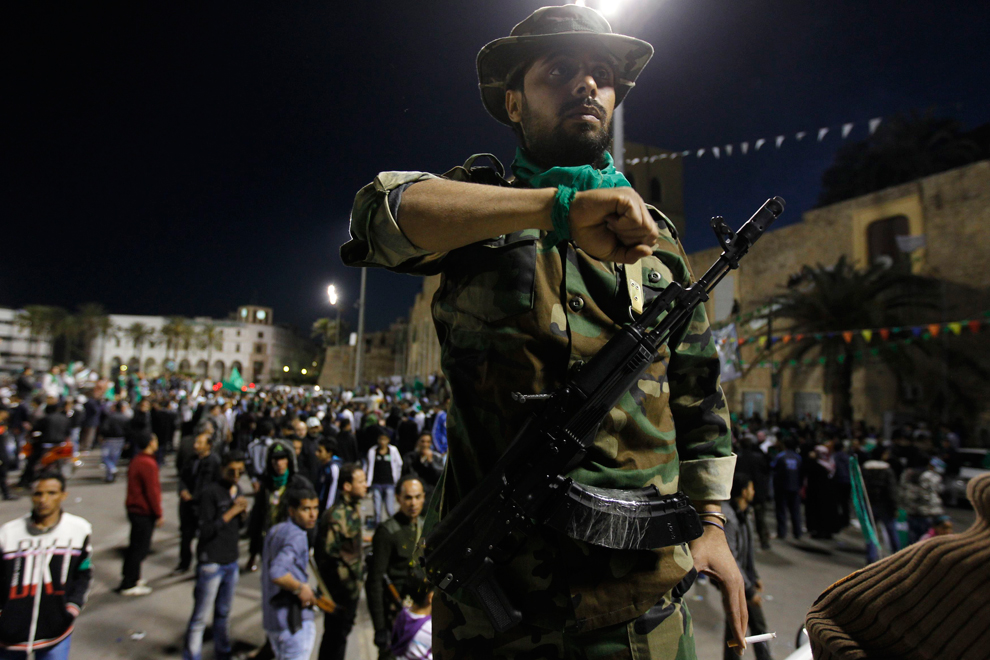
A soldier from the Libyan army stands at Green Square in Tripoli March 20. Western forces pounded Libya's air defenses and patrolled its skies on Sunday, but their day-old intervention hit a serious diplomatic setback as the Arab League chief condemned the "bombardment of civilians". (Zohra Bensemra/Reuters)


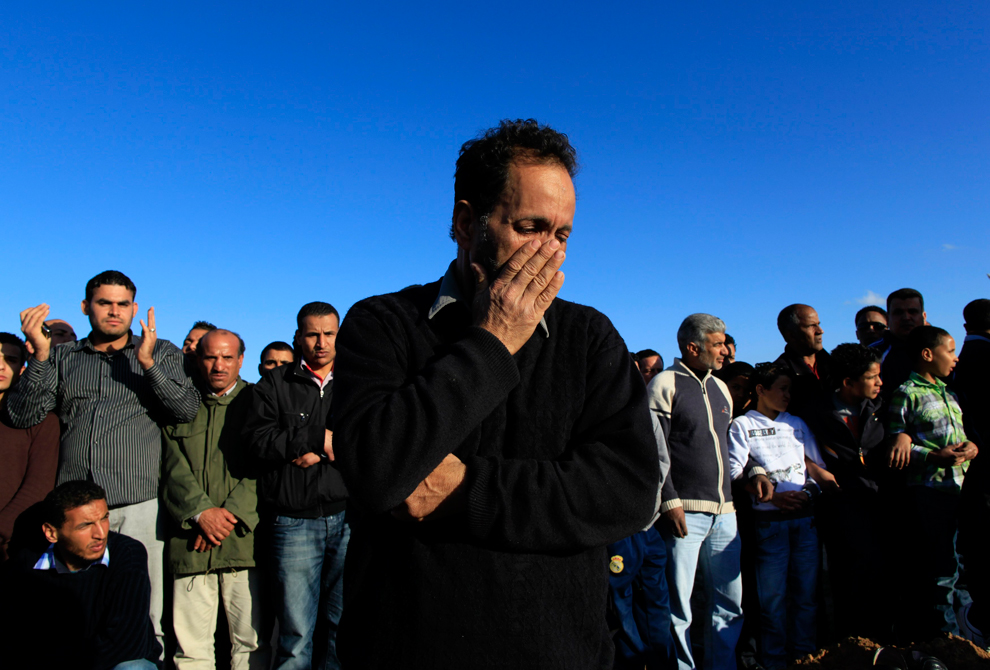
Libyans mourn during the funeral of the people who were killed after air strikes by coalition forces, at the martyrs' cemetery in Tripoli March 20. (Ahmed Jadallah/Reuters)


Libyans mourn during the funeral of the people who were killed after air strikes by coalition forces, at the martyrs' cemetery in Tripoli March 20. (Ahmed Jadallah/Reuters)


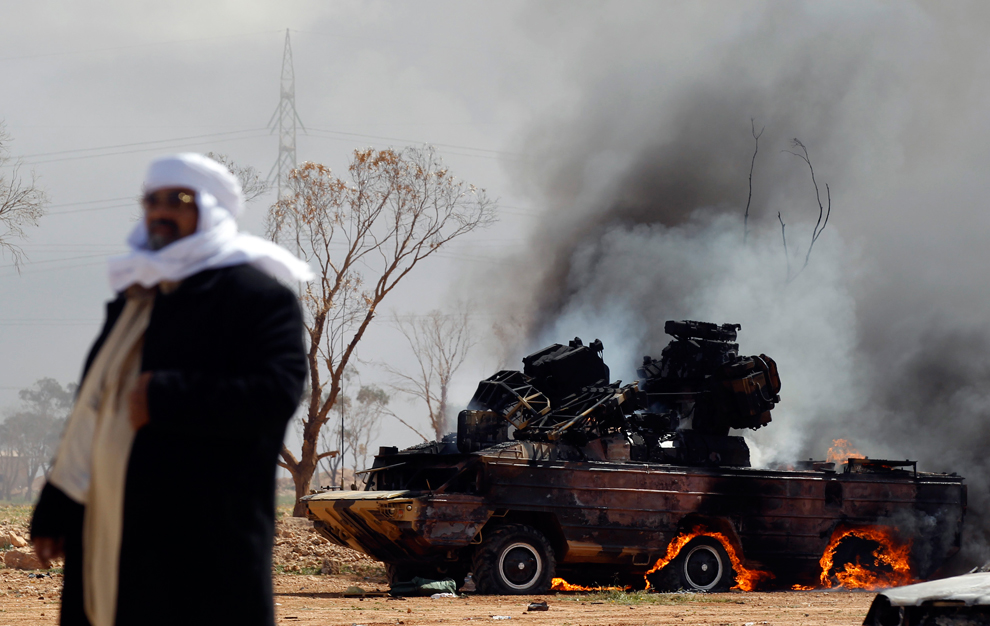
A man stands in front of a burning vehicle belonging to forces loyal to Muammar Qaddafi after an air strike by coalition forces, along a road between Benghazi and Ajdabiyah March 20. (Goran Tomasevic/Reuters) #


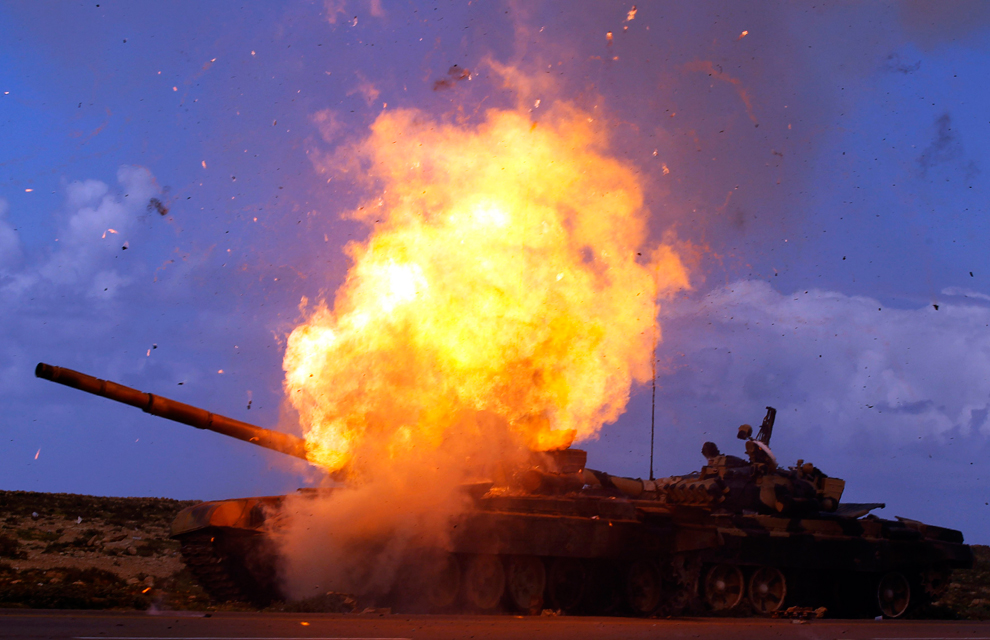
A tank belonging to forces loyal to Muammar Qaddafi explodes after an air strike by coalition forces, along a road between Benghazi and Ajdabiyah March 20. (Goran Tomasevic/Reuters)


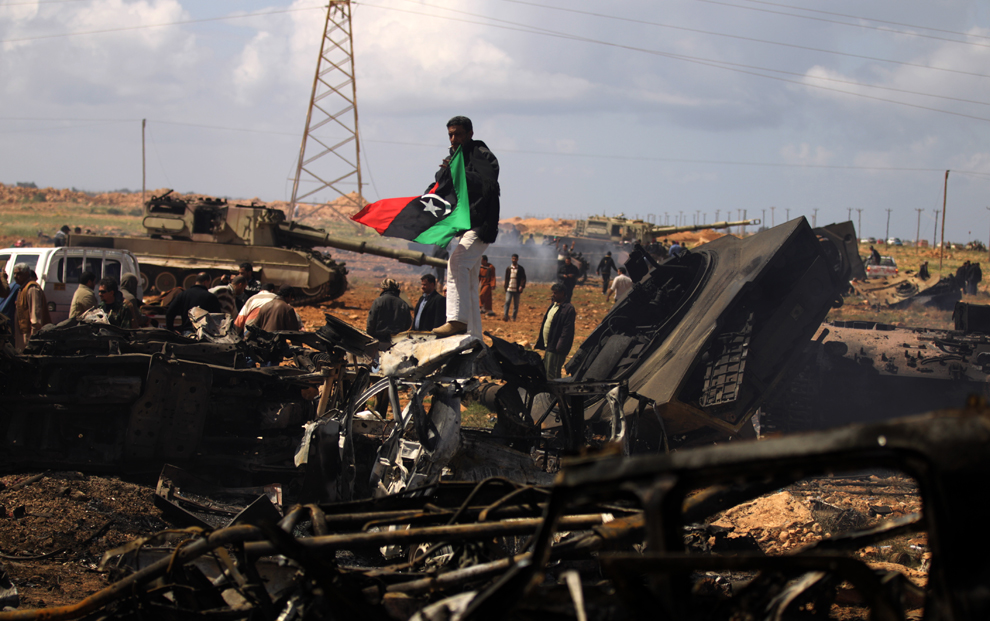
A Libyan rebel holds the rebellion flag as he steps over wrecked military vehicles belonging to Moammar Qaddafi forces hit by French warplanes on March 20. Dozens of Qaddafi military vehicles were destroyed in morning air strikes by the coalition west of Benghazi, as a semblance of normality returned with cars out on the road and street markets reopened in the rebel bastion. (Patrick Baz/AFP/Getty Images)


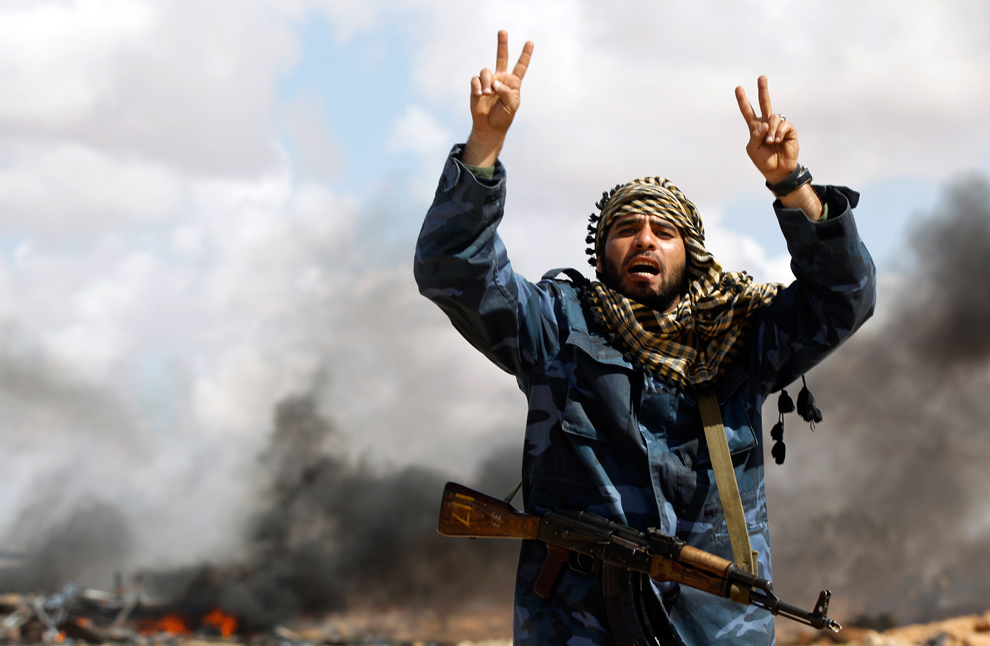
A rebel fighter shouts in front of a burning vehicle belonging to forces loyal to Muammar Qaddafi after an air strike by coalition forces, along a road between Benghazi and Ajdabiyah March 20. (Goran Tomasevic/Reuters)


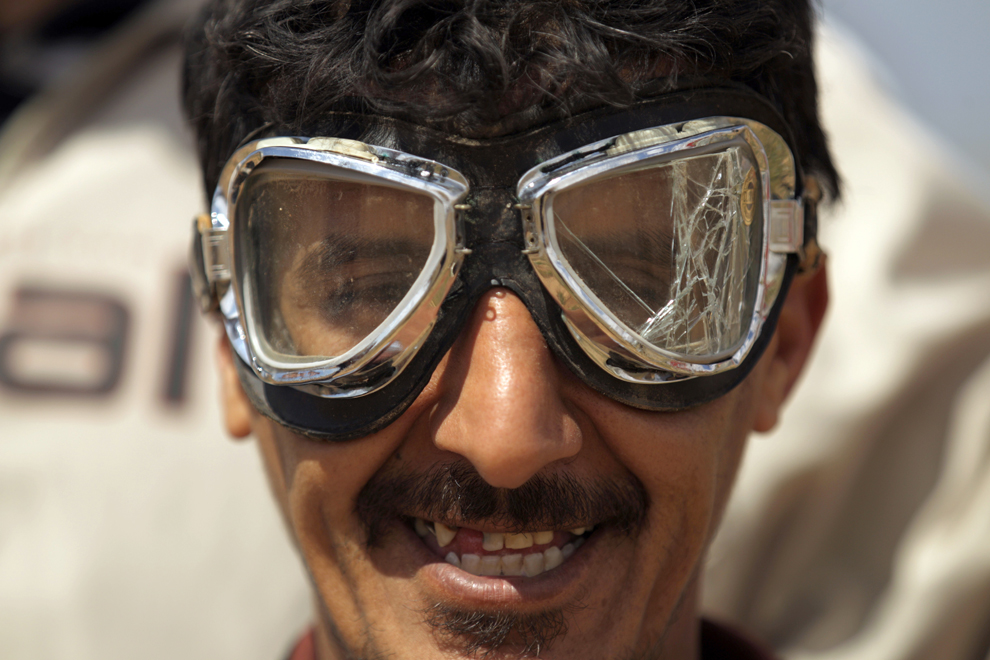
A Libyan rebel smiles next to wrecked military vehicles belonging to Moammar Qaddafi forces hit by French warplanes on March 20. (Patrick Baz/AFP/Getty Images)


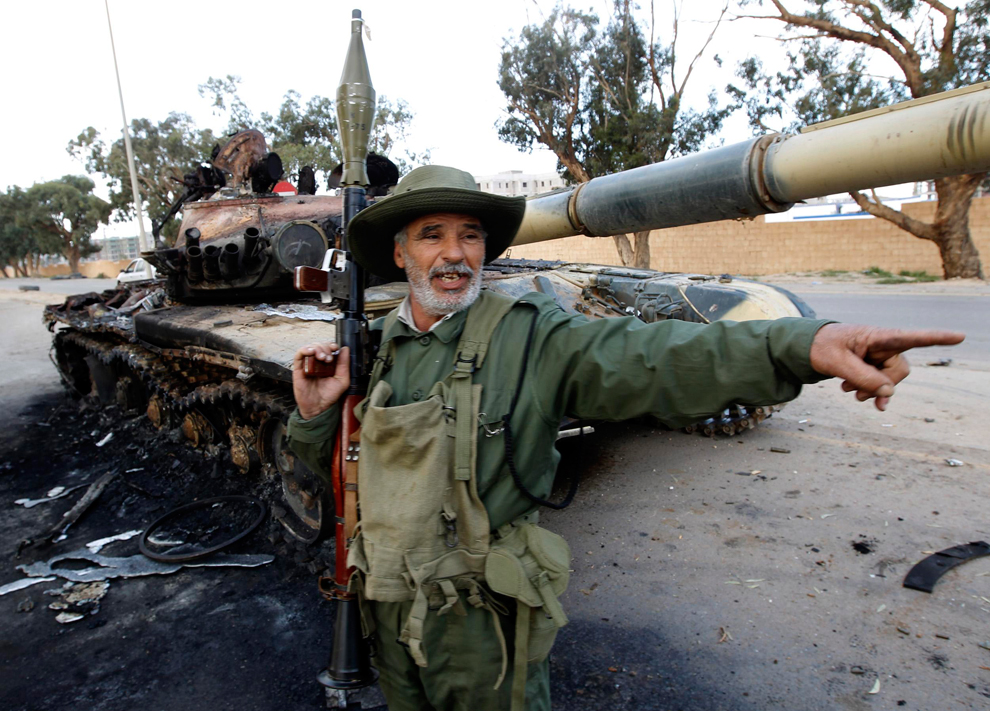
An elderly rebel fighter gestures in front of a destroyed tank belonging to forces loyal to Muammar Qaddafi after an air strike by coalition forces in Benghazi March 20. (Goran Tomasevic/Reuters)


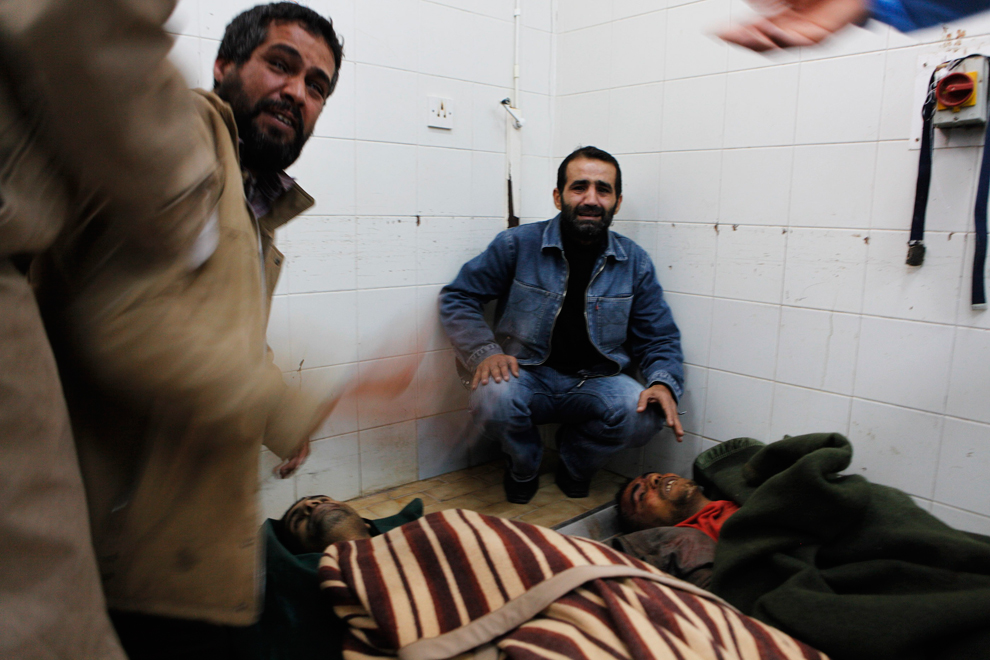
Men weep beside the bodies of family members killed during Saturday's offensive by forces loyal to Muammar Qaddafi in the northeastern city of Benghazi on March 20. (Finbarr O'Reilly/Reuters)


A man looks at a destroyed tank belonging to forces loyal to Muammar Qaddafi after an air strike by coalition forces, along a road between Benghazi and Ajdabiyah March 20. (Suhaib Salemk/Reuters)


Rebel fighters gesture in front of burning vehicles belonging to forces loyal to Muammar Qaddafi after an air strike by coalition forces along a road between Benghazi and Ajdabiyah March 20. (Goran Tomasevic/Reuters)


Curious Libyan onlookers take pictures of dead African teenagers, members of Muammar Qaddafi's forces hit by airstrikes by French warplanes in al-Wayfiyah west of Benghazi, on March 20 in al-Wayfiyah. (Patrick Baz/AFP/Getty Images)


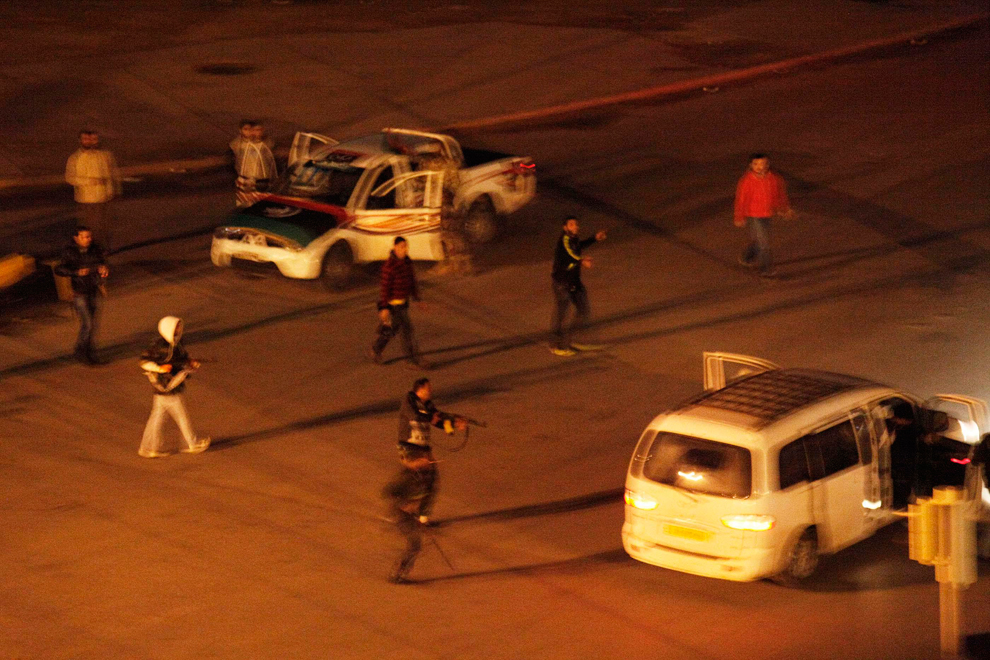
Rebel fighters point their weapons at a vehicle at a checkpoint during a gun battle in downtown Benghazi on March 20. Sporadic explosions and heavy gunfire broke out in central Benghazi at around 10 p.m. and lasted about 40 minutes, a Reuters witness reported from the city. (Finbarr O'Reilly/Reuters)


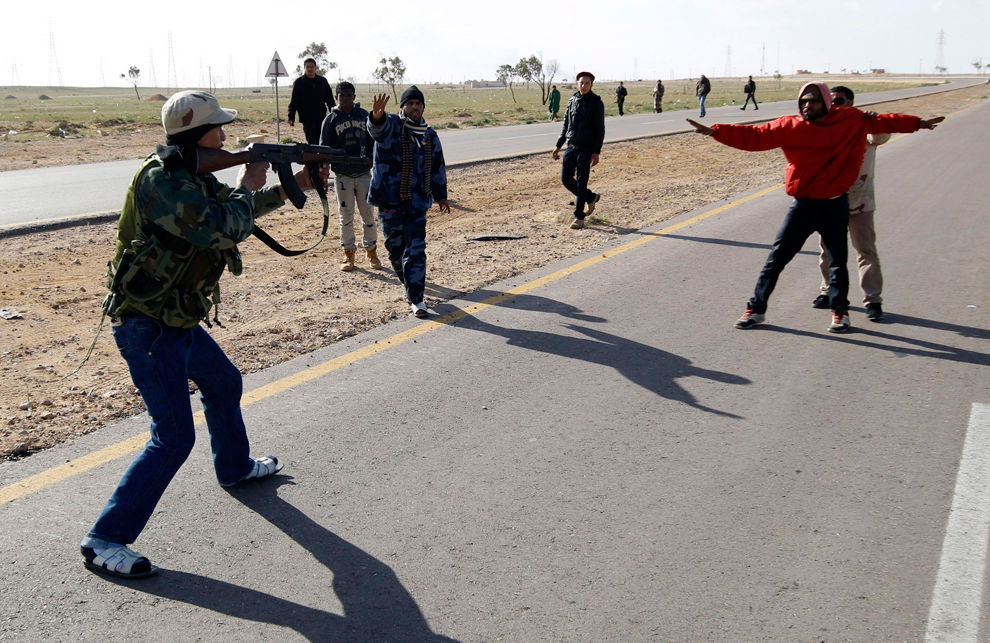
A rebel fighter points his gun at a suspected Qaddafi supporter as other rebels try to protect the suspected supporter, on a road between Benghazi and Ajdabiyah on March 21. (Goran Tomasevic/Reuters)


Libyan rebels retreat with their injured under heavy fire following a failed attempt to take the town of Ajdabiya from Moammar Qaddafi's forces on March 21. (Patrick Baz/AFP/Getty Images)


Mourners react during the funeral of Libyans killed by forces loyal to Muammar Qaddafi, in Benghazi March 21. (Suhaib Salem/Reuters)


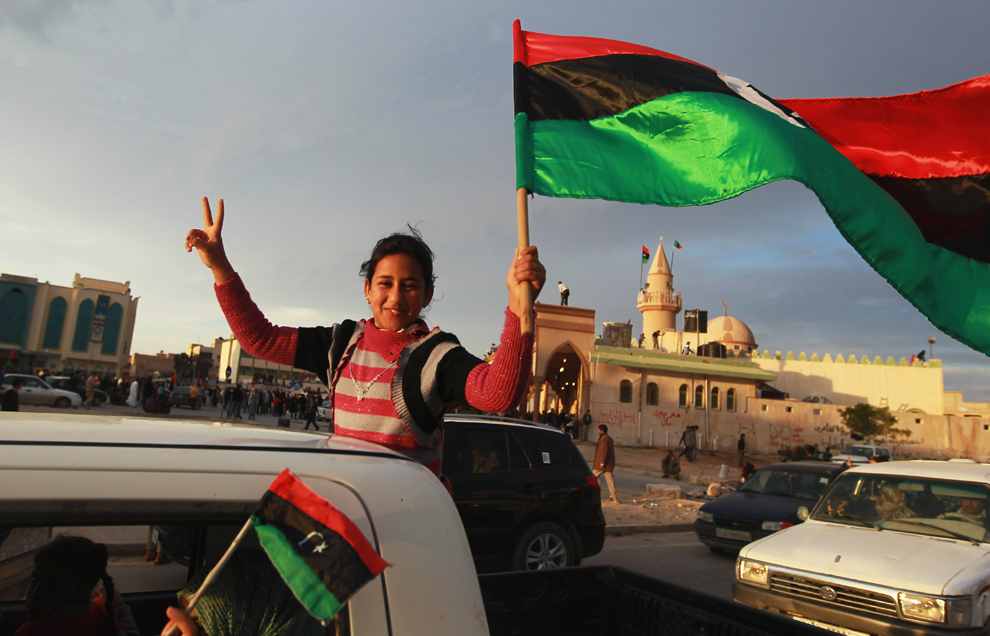
A young girl flashes the victory sign during a celebratory rally after the United Nations approved a no-fly zone over the country on March 18 in Tobruk. (Joe Raedle/Getty Images)


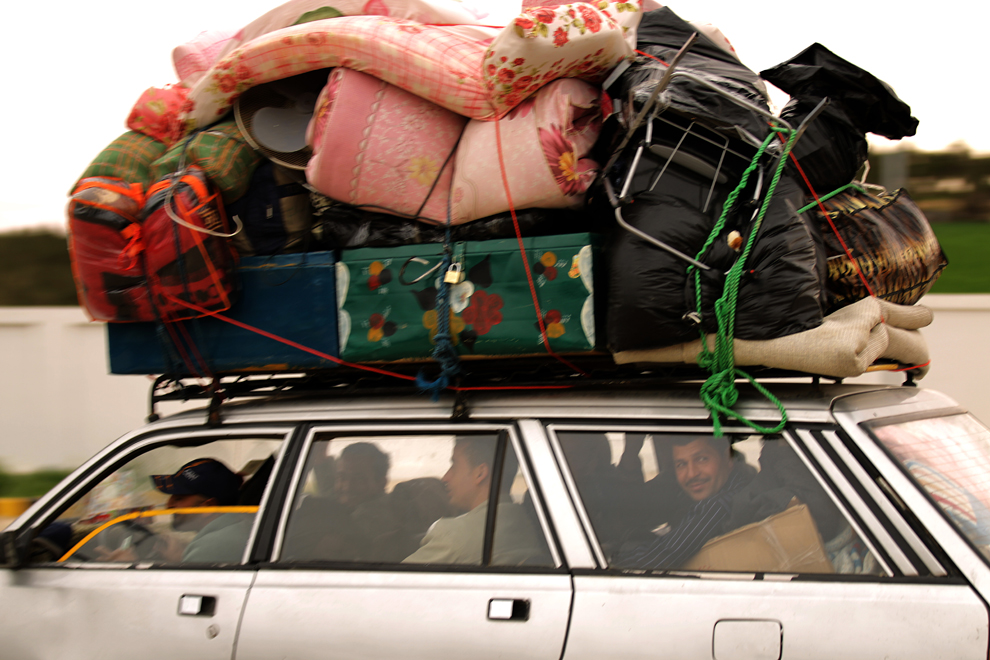
People flee the Libyan city of Benghazi through the town of Al-Marej on March 17. Libya warned it could target all Mediterranean air and sea traffic in the case of foreign military intervention. (Patrick Baz/AFP/Getty Images)


A Libyan girl fleeing Benghazi sits in a bus on March 19 as the exodus of civilians began shortly after the first air strikes hit Benghazi. (Patrick Baz/AFP/Getty Images)


A Libyan family, who fled their house after shelling from troops loyal to Muammar Qaddafi, takes shelter in a university in Tobruk, east of Tripoli, March 19. (Suhaib Salem/Reuters)

“Operation Libya” and the Battle for Oil - The geopolitical and economic implications of a US-NATO

Prof Michel Chossudovsky
Global Research

The geopolitical and economic implications of a US-NATO led military intervention directed against Libya are far-reaching.

Libya is among the World’s largest oil economies with approximately 3.5% of global oilreserves, more than twice those of the US.

“Operation Libya” is part of  the broader military agenda in the Middle East and Central Asia which consists in gaining control and corporate ownership over more than sixty percent of the world’s reserves of oil and natural gas, including oil and gas pipeline routes.

“Muslim countries including Saudi Arabia, Iraq, Iran, Kuwait, the United Arab Emirates, Qatar, Yemen, Libya, Egypt, Nigeria, Algeria, Kazakhstan, Azerbaijan, Malaysia, Indonesia, Brunei, possess between 66.2 and 75.9 percent of total oil reserves, depending on the source and methodology of the estimate.” (See Michel Chossudovsky, The “Demonization” of Muslims and the Battle for Oil, Global Research, January 4, 2007) .

With 46.5 billion barrels of proven reserves, (10 times those of Egypt), Libya is the largest oileconomy in the African continent followed by Nigeria and Algeria (Oil and Gas Journal). In contrast, US proven oil reserves are of the order of 20.6 billion barrels (December 2008) according to the Energy Information Administration.  U.S. Crude Oil, Natural Gas, and Natural Gas Liquids Reserves)


Operation Libya and the Battle for Oil

Operation Libya and the Battle for Oil  2011%20African%20Oil%20Reserve%20Holders

Note

The most recent estimates place Libya’s oil reserves at 60 billion barrels. Its gas reserves at 1,500 billion m3. Its production has been between 1.3 and 1.7 million barrels a day, well below its productive capacity. Its longer term objective is three million b/d and a gas production of 2,600 million cubic feet a day, according to figures of the National OilCorporation (NOC).

The (alternative) BP Statistical Energy Survey (2008) places Libya’s proven oil reserves at 41.464 billion barrels at the end of 2007 which represents 3.34 % of the world’s proven reserves. (Mbendi Oil and Gas in Libya – Overview).


Oil is the “Trophy” of US-NATO led Wars

An invasion of Libya would serve the same corporate interests as the 2003 invasion and occupation of Iraq. The underlying objective is to take possession of Libya’s oil reserves, destabilize the National Oil Corporation (NOC) and eventually privatize the country’s oilindustry, namely transfer the control and ownership of Libya’s oil wealth into foreign hands.

The National Oil Corporation (NOC) is ranked 25 among the world’s Top 100 Oil Companies. (The Energy Intelligence ranks NOC 25 among the world’s Top 100 companies. – Libyaonline.com)

The planned invasion of Libya, which is already underway is part of the broader “Battle forOil”.  Close to 80 percent of Libya’s oil reserves are located in the Sirte Gulf basin of EasternLibya. (See map below)

Libya is a Prize Economy. “War is good for business”. Oil is the trophy of US-NATO led wars.

Wall Street, the Anglo-American oil giants, the US-EU weapons producers would be the unspoken beneficiaries of a US-NATO led military campaign directed against Libya.

Libyan oil is a bonanza for the Anglo-American oil giants. While the market value of crude oilis currently well in excess of 100 dollars a barrel, the cost of Libyan oil is extremely low, as low as $1.00 a barrel (according to one estimate). As one oil market expert commented somewhat cryptically:

“At $110 on the world market, the simple math gives Libya a $109 profit margin.” (Libya Oil, Libya Oil One Country’s $109 Profit on $110 Oil, EnergyandCapital.com March 12, 2008)

Foreign Oil Interests in Libya

Foreign oil companies operating prior to the insurrection in Libya include France’s Total, Italy’s ENI, The China National Petroleum Corp (CNPC), British Petroleum, the Spanish Oilconsortium REPSOL, ExxonMobil, Chevron, Occidental Petroleum, Hess, Conoco Phillips.

Of significance, China plays a central role in the Libyan oil industry. The China National Petroleum Corp (CNPC) had until its repatriation a Chinese workforce in Libya of 30,000. British Petroleum (BP) in contrast had a British workforce of 40 which ahs been repatriated.

Eleven percent (11%) of Libyan oil exports are channelled to China. While there are no figures on the size and importance of CNPC’s production and exploration activities, there are indications that they are sizeable.

More generally, China’s presence in North Africa is considered by Washington to constitute an intrusion. From a geopolitical standpoint, China is an encroachment. The military campaign directed against Libya is intent upon excluding China from North Africa.

Also of importance is the role of Italy. ENI, the Italian oil consortium puts out 244,000 barrels of gas and oil, which represents almost 25 percent of Libya’s total exports. ( Sky News: Foreign Oil firms halt Libyan operations, February 23, 2011).

Among US companies in Libya, Chevron and Occidental Petroleum (Oxy) decided barely 6 months ago (October 2010) not to renew their oil and gas exploration licenses in Libya. Did they have advanced knowledge of the insurrection? (Why are Chevron and Oxy leaving Libya?: Voice of Russia, October 6, 2010). In contrast, in November 2010, Germany oil oil company, R.W. DIA E signed a far-reaching agreement with Libya’s National Oil Corporation (NOC) involving exploration and production sharing. AfricaNews – Libya: German Oil firm signs prospecting deal – The AfricaNews,

The financial stakes as well  as “the spoils of war” are extremely high. The military operation is intent upon dismantling Libya’s financial institutions as well as confiscating billions of dollars of Libyan financial assets deposited in Western banks.

It should be emphasised that Libya’s military capabilities, including its air defense system are weak.

Operation Libya and the Battle for Oil  LibyaLandEmergOpps fig1

Libya Oil Concessions
Operation Libya and the Battle for Oil


Redrawing of the Map of Africa

Libya has the largest oil reserves in Africa. The objective of US-NATO interference is strategic: it consists in outright theft, in stealing the nation’s oil wealth under the disguise of a humanitarian intervention.

This military operation is intent upon establishing US hegemony in North Africa, a region historically dominated by France and to lesser extent by Italy and Spain.

With regard to Tunisia, Morocco and Algeria, Washington’s design is to weaken the political links of these countries to France and push for the installation of new political regimes which have a close rapport with the US. This weakening of France as part of a US imperial design is part of a historical process which goes back to the wars in Indochina.

US-NATO intervention leading to the eventual formation of a US puppet regime is also intent upon excluding China from the region and edging out China’s National Petroleum Corp (CNPC). The Anglo-American oil giants including British Petroleum which signed an exploration contract in 2007 with the Ghadaffi government are among the potential “beneficiaries” of  the proposed US-NATO military operation.

More generally, what is at stake is the redrawing of the map of Africa, a process of neo-colonial redivision, the scrapping of the demarcations of the 1884 Berlin Conference, the conquest of Africa by the United States in alliance with Britain, in a US-NATO led operation.

Operation Libya and the Battle for Oil

The colonial redivision of Africa. 1913

Libya: Strategic Saharan Gateway to Central Africa

Libya has borders with several countries which are in the French sphere of influence including Algeria, Tunisia, Niger and Chad.

Chad is potentially an oil rich economy. ExxonMobil and Chevron have interests in Southern Chad including a pipeline project. Southern Chad is a gateway into the Darfur region of Sudan. China has oil interests in both Chad and Sudan. The China National Petroleum Corp (CNPC) signed a farreaching agreement with the Chad government in 2007.

Niger is strategic to the United States in view of its extensive reserves of uranium. At present,France dominates the uranium industry in Niger through the French nuclear conglomerate Areva, formerly known as Cogema. China also has a stake in Niger’s uranium industry.

More generally, the Southern border of Libya is strategic for the United States in its quest to extend its sphere of influence in Francophone Africa, a vast territory extending from North Africa to Central and Western Africa. Historically this region was part of France and Belgium’s colonial empire, the borders of which were established  at the Berlin Conference of 1884.

Operation Libya and the Battle for Oil  87 map of francophone africa

Source www.hobotraveler.com

The US played a passive role in the 1884 Berlin Conference. This new 21st Century redivision of the African continent, predicated on the control over oil, natural gas and strategic minerals (cobalt, uranium, chromium, manganese, platinum and uranium) largely supports dominant Anglo-American corporate interests.

US interference in North Africa redefines the geopolitics of an entire region. It underminesChina and overshadows the influence of the European Union.

This new redivision of Africa not only weakens the role of the former colonial powers (including France and Italy) in North Africa. it  is also part of a broader process of displacing and weakening France (and Belgium) over a large part of the African continent.

US puppet regimes have been installed in several African countries which historically were in the sphere of influence of France (and Belgium), including The Republic of the Congo and Rwanda.  Several countries in West Africa within the sphere of France (including Côte d’Ivoire) are slated to become US proxy states.

The European Union is heavily dependent on the flow of Libyan oil. 85 percent of its oil is sold to European countries. In the case of a war with Libya, the supply of petroleum to Western Europe could be disrupted, largely affecting Italy, France and Germany, which are heavily dependent on Libyan oil. The implications of these disruptions are far-reaching. They also have direct bearing on the relationship between the US and the European Union.

Concluding Remarks

The mainstream media through massive disinformation is complicit in justifying a military agenda which, if carried out, would have devastating consequences not only for the Libyan people: the social and economic impacts would be felt Worldwide.

There are at present three distinct war theaters in the broader Middle East Central Asian region: Palestine, Afghanistan, Iraq. In the case of an attack on Libya, a  fourth war theater would be opened up in North Africa, with the risk of military escalation.

Public opinion must take cognizance of the hidden agenda behind this alleged humanitarian undertaking, heralded by the heads of state and heads of government of NATO countries as a “Just War”. The Just War theory in both its classical and contemporary versions upholds waras a “humanitarian operation”. It calls for military intervention on ethical and moral grounds against “rogue states” and “Islamic terrorists”. The Just war theory demonizes the Ghadaffi regime while providing

The heads of state and heads of government of NATO countries are the architects of war and destruction in Iraq and Afghanistan. In an utterly twisted logic, they are heralded as the voices of reason, as the representatives of the “international community”.

Realities are turned upside down. A humanitarian intervention is launched by war criminals in high office, who are the guardians of the Just War theory.

Abu Ghraib, Guantanamo,… Civilian casualties in Pakistan resulting from US drone attacks on town and villages, ordered by president Obama are not front page news, nor are the 2 million civilian deaths in Iraq. There is no such thing as a “Just War”.

The history of US imperialism should be understood. The 2000 Report of the Project of the New American Century entitled “Rebuilding Americas’ Defenses” calls for the implementation of a long war, a war of conquest. One of the main components of this military agenda is: to“Fight and decisively win in multiple, simultaneous theater wars”.

Operation Libya is part of that process. It is another theater in the Pentagon’s logic of “simultaneous theater wars”.

The PNAC document faithfully reflects the evolution of US military doctrine since 2001. The US plans to be involved simultaneously in several war theaters in different regions of the World.

While protecting America, namely “National Security” of the United States of America is upheld as an objective, the PNAC report does spell out why these multiple theater wars are required. The humanitarian justification is not mentioned.

What is the purpose of America’s military roadmap?

Libya is targeted because it is one among several remaining countries outside America’s sphere of influence, which fail to conform to US demands. Libya is a country which has been selected as part of a military “road map” which consists of “multiple simultaneous theater wars”.  In the words of former NATO Commander Chief General Wesley Clark:

“in the Pentagon in November 2001, one of the senior military staff officers had time for a chat. Yes, we were still on track for going against Iraq, he said. But there was more. This was being discussed as part of a five-year campaign plan, he said, and there were a total of seven countries, beginning with Iraq, then Syria, Lebanon, Libya, Iran, Somalia and Sudan…. (Wesley Clark, Winning Modern Wars, p. 130).


Darkpolitricks.com

Related Posts Plugin for WordPress, Blogger...

MP3 Clips

Popular Posts